



For many lenders, the loan origination system (LOS) has long been considered a necessary part of the technology stack. It provides structure, enforces process, and helps manage the flow of deals from intake through approval.
For larger institutions with complex operations, that model still makes sense. But not every lending team operates at that level of scale. Across commercial lending, a growing number of smaller and mid-sized institutions are asking a different question: do we need a full LOS today, or do we need a better way to run our credit workflow?
For teams managing lean operations, the challenge is not replacing an LOS. It is building structure without adding unnecessary complexity. This is where a new approach is emerging, one that focuses on simplifying the credit workflow while still supporting speed, consistency, and growth.
Key Insights at a Glance
- Not all lenders require a full LOS to run an effective credit operation
- Lean teams often struggle with fragmented, spreadsheet-driven workflows
- The real need is structure, not system overhead
- Manual spreading and disconnected tools slow decision-making
- Centralizing financial data and analysis improves consistency and speed
- FlashSpread provides a streamlined, structured alternative to traditional workflows
The Gap Between Spreadsheets and Full Systems
Many lending teams find themselves in a familiar position. They have outgrown spreadsheets, but they are not ready, or do not need, to implement a full LOS.
In this middle stage, workflows often look like this:
- Financial data is spread manually in spreadsheets
- Documents are stored across shared drives or email
- Credit analysis happens in separate tools
- Policy interpretation relies on senior team members
- Deal visibility is limited across the pipeline
While each piece may function independently, the overall process becomes fragmented.
Over time, this creates several challenges:
- Manual data entry slows deal turnaround
- Inconsistent formats complicate analysis
- Disconnected tools limit visibility
- Tribal knowledge drives decision inconsistency
- Growth requires additional headcount
At this stage, the bottleneck is not deal flow. It is the process itself.
Why a Full LOS Isn’t Always the Right Next Step
When these challenges emerge, the default assumption is often to implement an LOS.
However, for many smaller or growing teams, a full LOS introduces its own set of tradeoffs:
- Significant implementation time
- High upfront and ongoing cost
- Rigid workflows that may not match internal processes
- Additional operational overhead
For teams focused on improving efficiency and scaling gradually, this can feel like overcorrection. The need is not necessarily a larger system. It is a better-structured workflow.

What Lean Credit Teams Actually Need
When you step back from systems and focus on outcomes, the requirements become clearer. Most credit teams need to:
- Move from document intake to structured financial data quickly
- Standardize how deals are evaluated
- Reduce manual data entry and rework
- Improve visibility across deals
- Scale operations without adding headcount
These needs are centered around the credit process itself, not the system that houses it.
This is why many teams are shifting toward workflow-first thinking. Instead of building around a single platform, they focus on creating a streamlined process that supports underwriting from end to end.
Where Time Is Lost in Today’s Workflow
To understand what needs to change, it helps to look at where time is currently spent.
1. Manual Financial Spreading
Financial documents arrive in inconsistent formats. Analysts must extract, validate, and categorize data before analysis can begin.
This step alone can take hours per deal.
2. Data Cleanup and Validation
Even after initial spreading, data must be reviewed:
- Are totals accurate?
- Are line items categorized correctly?
- Are periods consistent?
Errors at this stage often lead to rework later.
3. Rework Loops
When issues are identified during underwriting:
Subscribe to BeSmartee 's Digital Mortgage Blog to receive:
- Mortgage Industry Insights
- Security & Compliance Updates
- Q&A's Featuring Mortgage & Technology Experts
- Data is corrected
- Ratios are recalculated
- Reports are updated
These loops slow decision velocity and reduce overall efficiency.
4. Limited Visibility Across Deals
Without a centralized workflow, it becomes difficult to track:
- Deal status
- Analyst workload
- Bottlenecks in the process
This limits a team’s ability to scale effectively.
A More Streamlined Approach to Credit Workflow
Rather than jumping directly to a full LOS, many teams are adopting a more focused approach.
The goal is to centralize the critical parts of the credit process:
- Document intake
- Financial spreading
- Data validation
- Credit analysis
When these elements are brought into a single structured workflow, teams gain:
- Faster turnaround times
- More consistent analysis
- Better visibility across deals
- Reduced dependency on manual processes
This creates the structure teams need, without the overhead of a large system.
How FlashSpread Supports a Lean Credit Workflow
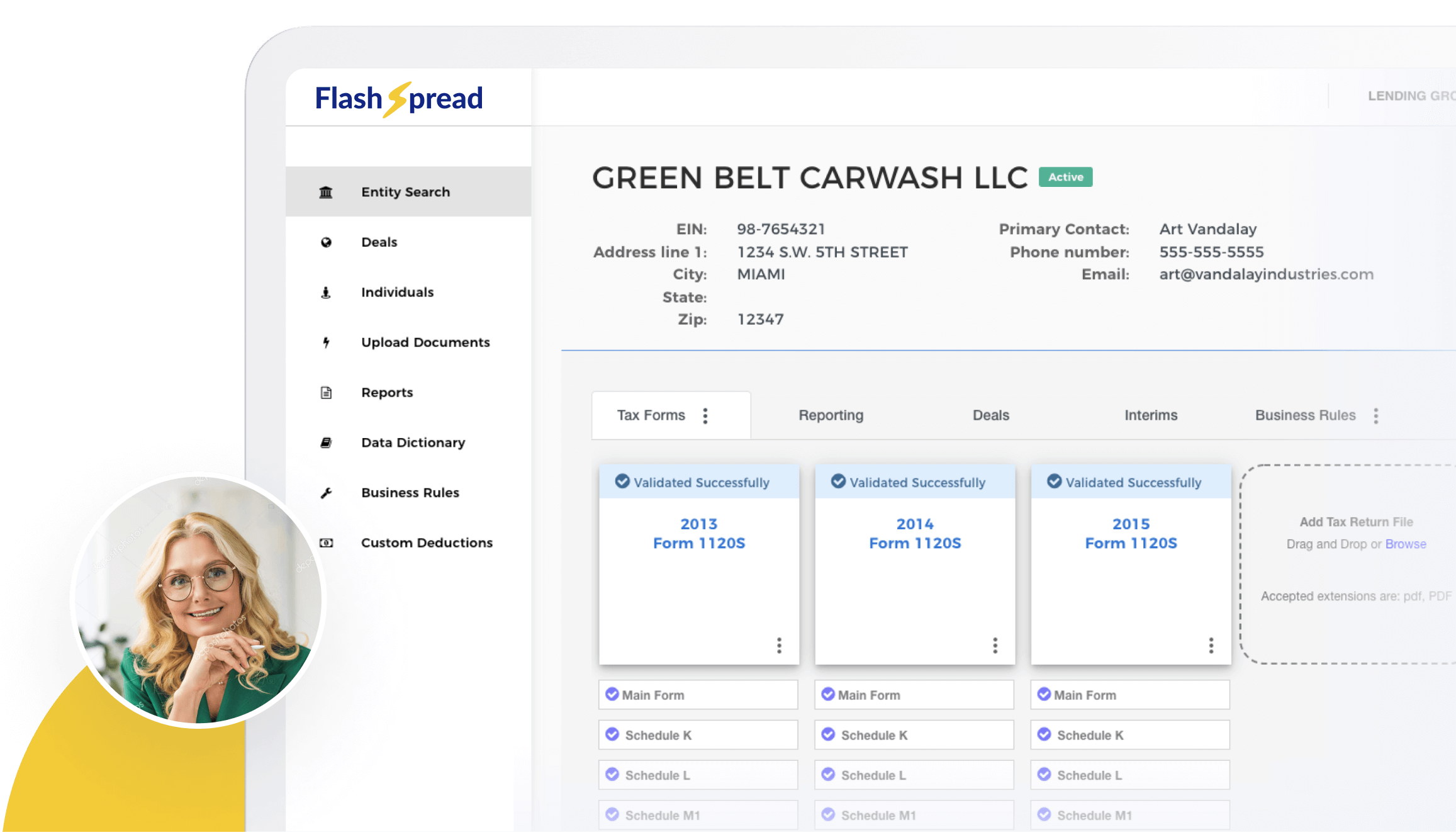
FlashSpread is designed to provide that structure, without requiring a full LOS. At its core, FlashSpread supports the credit workflow from document intake through underwriting by focusing on what matters most: financial data and how it is used.
Using OCR and machine learning, FlashSpread extracts and organizes data from tax returns, income statements, and balance sheets. Instead of manually rekeying information, analysts receive structured, normalized financials that are ready for review.

This enables:
- Faster processing: Reduce manual spreading time significantly, turning hours of work into minutes
- Consistent data structure: Standardize how financials are categorized across deals
- Reduced rework: Clean, validated data minimizes downstream corrections
- Improved efficiency: Analysts can focus on credit decisions rather than data preparation
Beyond spreading, FlashSpread helps centralize the broader credit workflow:
- Intake and document handling
- Financial data preparation
- Credit analysis support
- Visibility across deals
For many lean teams, this effectively becomes the operational core of their credit process. It provides the structure they need to scale, without the cost and complexity of a full LOS.
Scaling Without System Overhead
One of the biggest challenges for growing lending teams is scaling operations without proportionally increasing headcount.
When workflows rely heavily on manual processes, growth becomes linear: More deals → more analysts → higher cost
By introducing structured workflows and automated data preparation, teams can break that pattern. FlashSpread helps enable this by:
- Eliminating manual data entry bottlenecks
- Reducing rework cycles
- Standardizing analysis across the team
As a result, teams can handle higher deal volumes without adding significant operational overhead.
Roundup
Not every lender needs a full LOS to run an effective credit operation. For many teams, the real challenge is not system capability. It is workflow structure. Spreadsheets and disconnected tools can only scale so far before they become the bottleneck.
A more streamlined approach focuses on centralizing the core credit workflow, bringing structure to financial data, standardizing analysis, and improving visibility across deals. For lean lending teams, this provides a practical path forward. It delivers the benefits of structure and consistency without the cost and complexity of a large system.
If your team has outgrown spreadsheets but isn’t ready for a full LOS, it may be time to rethink how your credit workflow is built. Explore how FlashSpread helps teams move from document intake to decision-ready financials faster, with a workflow designed to scale.